October 2026 · Applied AI, local inference, and reproducible evaluation.
Public project · offline OCR in the browser
BP Log · bp-tracker
A phone web app that reads a blood-pressure monitor’s display from a photo, then lets the user check and correct the values before saving. Image-processing rules handle the display layout; a 10,123-parameter CNN trained on synthetic digits runs in plain JavaScript with a 54 KB weights file.
Published evaluation: 91% complete readings on 55 photos from one monitor; 99.5% digit accuracy on 187 held-out digits. The full reading set guided pipeline development, so it is not an independent holdout. Median phone latency: 268 ms across three runs on an Android 10 phone.
Read project and evidence ↗Professional work · demonstrator and funded proposal
AgentDiet
I conceived an agent-governance project at MCQ Scan: signed Biscuit tokens, attenuated delegations, and local Datalog checks for tool permissions. I built a Python/FastAPI demonstrator and prepared the technical proposal, market analysis, budget, and project plan. AgentDiet received a 2026 Hyper Open X grant funded by France 2030.
The demonstrator validates simulated authorizations; MCP/A2A integration is the project target.
Read project and evidence ↗Professional work · structured-output evaluation
Store Chat
A clothing-shopping assistant with Llama 3.1 8B LoRA, local vLLM inference, and Pydantic business validation. I evaluated constrained-decoding tools and integrated LM Format Enforcer to enforce enum values. Internal evaluation separates 97% structurally valid, enum-compliant requests from 95% semantic accuracy per attribute.
These are internal evaluation results, not a public benchmark. My contribution was tool evaluation and integration, not a custom sampler.
Read project and evidence ↗Public source · self-hosted audiobook studio
Whispbook · web studio
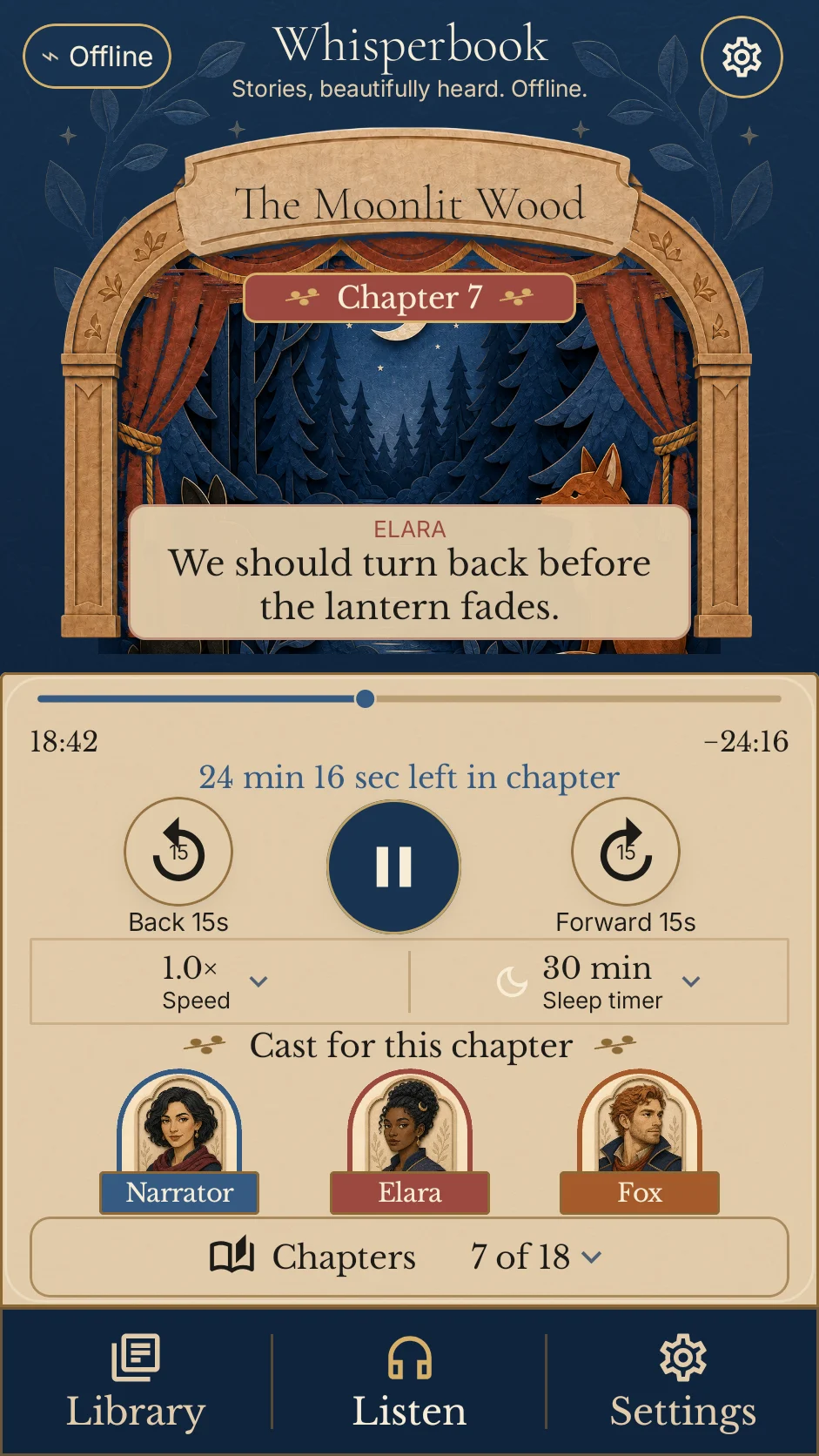
A React/FastAPI studio for importing and editing documents, assigning character voices, and generating chapter audio with Kokoro or Chatterbox. It exports M4B audiobooks, subtitles, and Python scripts that preserve the edited text and synthesis settings.
Separate from the Android app. The current web app does not integrate the separate model-based speaker-attribution experiment.
Read project and evidence ↗Personal experiment · mobile diffusion inference
Z-Image-Turbo · Android
Porting image generation to Nothing Phone 3: 512×512 output, a comparison of 100 runtime/precision configurations, INT8/INT4 quantization, and a QNN w8a16 path on the Hexagon NPU. The work includes numerical checks, activation-saturation diagnosis, and calibration across all diffusion steps.
Experimental work described in my October dossier. Single-block timings do not establish an end-to-end generation speedup; no public repository is linked here.
Public benchmark · OnePlus 6T
Pocket TTS Android Benchmark
A pinned English INT8 Pocket TTS conversion running through sherpa-onnx on Android. On a OnePlus 6T with Android 11, CPU and two threads, the recorded real-time factors are 0.94, 1.01, and 1.06 for 2, 4, and 8 diffusion steps. Audio samples and machine-readable measurements are published.
One observed run per setting; not averages or a Whisperbook benchmark. RTF is generation time divided by audio duration.
Read project and evidence ↗Public experiment · negative result documented
Speculative decoding · MLX
Compared Qwen3 4B with a Qwen3 0.6B draft model on 40 labeled speaker-classification samples. Both paths reached 97.5% accuracy, but speculative decoding was 28.3% slower in the recorded protocol.
Short outputs and model loading inside each timed call limit the conclusion. This is not a steady-state serving benchmark.
Read project and evidence ↗